Text Me: Second Phone Number
- 4.2
- Rating
- 50.00M
- Installs
- Free
- Price

 Analysis by App-foxy
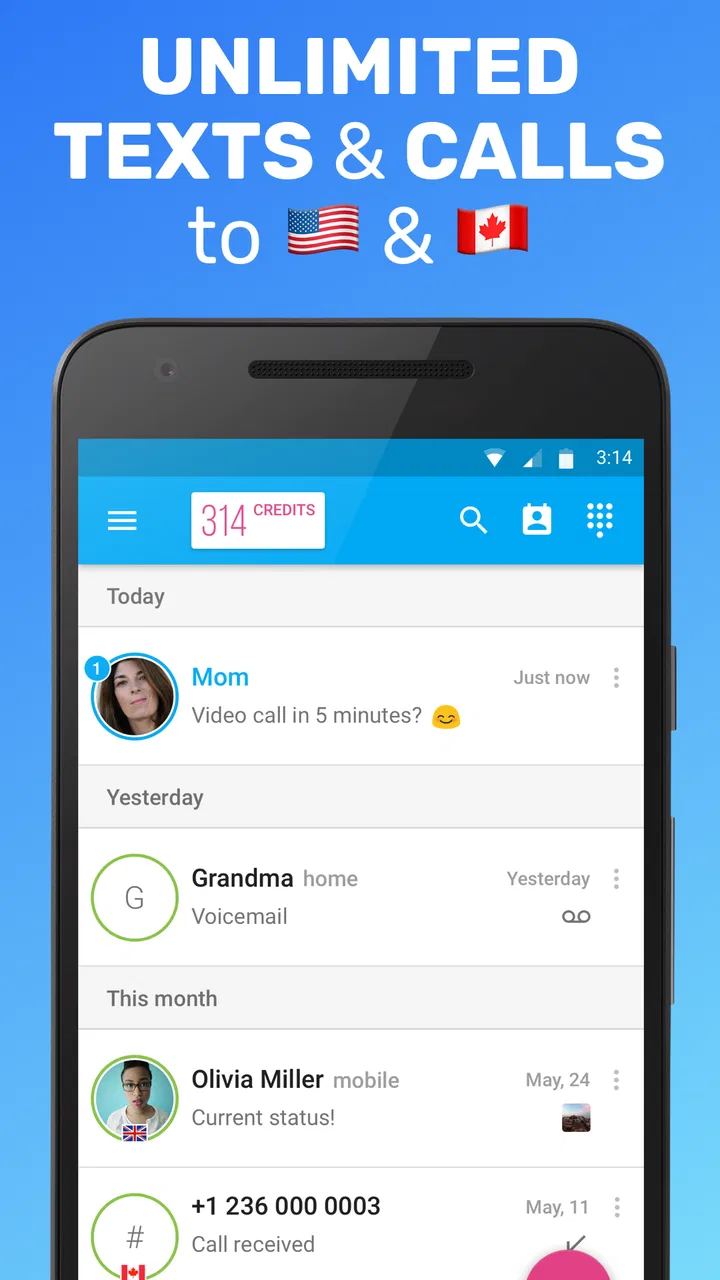
I tested Text Me: Second Phone Number as the kind of social app you open when your regular number is not the right tool for the conversation. Its main appeal is simple: it gives you a separate number for texting and calling, with a focus on communication involving the United States, Canada, and other supported destinations. That makes it useful for separating personal conversations from a temporary project, keeping a second line for online contacts, or giving someone a way to reach you without immediately sharing your everyday number.
What I like about this app is that it solves a very specific problem without asking you to carry another phone. What I do not like is that a second number is not automatically the same as a fully independent mobile line. Your experience depends on the people you need to contact, the destination involved, the app’s current calling and messaging support, and whether you are comfortable managing communication inside an app rather than through the phone’s normal dialer and messages screens.
From needing another number to completing a conversation
I find it helpful to judge Text Me by the whole path of a conversation, not just by how quickly I can start one. The next section looks at the practical handoffs—from choosing a separate number to getting a reply—and why a little planning can make this channel feel more dependable in everyday use.
You May Also Like

 Blood Strike: 2.5 Anniversary
Blood Strike’s Loadouts Turn Every Drop Into a Tactical Gamble
A close look at Blood Strike’s custom loadouts: how fast access to signature weapons reshapes its battle royale rhythm, rewards preparation, and narrows the gap between fights.

 Pandora - Music & Podcasts
Pandora’s Music Is Easy to Start, but Harder to Recover
Pandora’s strength is its low-effort path from a seed to a station. Its weak spot is how much confidence it asks you to place in connection, setup, and quiet recovery.

 8 Ball Pool
 Is Built on Rivalries, Rematches, and Routine
A close look at the rivalries, rematches, shared routines, and unanswered safety questions that turn a quick pool match into a persistent mobile community.

 Samsung Music
’s Quiet Strength Is Playing What You Already Own
Its reach comes less from spectacle than from dependable access to a personal library. That simplicity is both the app’s strongest retention engine and its ceiling.

 AccuWeather: Weather Radar
AccuWeather Review: A Quick, Clear Forecast for Everyday Decisions
For everyday plans, the best forecast is the one you can understand quickly. AccuWeather makes rain timing, radar, and local conditions easy to act on, with a few trade-offs.

 Hill Climb Racing
Why Hill Climb Racing Still Turns Crashes Into One More Run
A tiny car, a bumpy hill and one more upgrade: Hill Climb Racing keeps resurfacing because its simple chaos makes every near-miss feel personal.
More From Our News Desk
View All News


The starting condition: when your main number feels too exposed
A realistic example is arranging a local sale. I may need to exchange several messages with a stranger, coordinate a meeting, and answer a call if plans change. Using my personal number would make the conversation easy, but it would also connect that stranger to the number I use for family, work, account recovery, and other private matters. Text Me gives me a practical middle layer: I can communicate while keeping my usual number out of the initial exchange.
The same workflow can help with a short-term project, a community activity, a small side business, or travel planning with people I do not know well. It is also useful when I want a separate identity for messages that might otherwise clutter my normal inbox. I would not treat it as a magic privacy shield, but I do find the separation itself valuable. The important distinction is that this is a second communication channel, not merely a different color or layout for the number I already own.
Text Me is a free social app from TextMe, Inc., and its age rating is Everyone. It has been available since Aug 3, 2011, so it is not a new experiment trying to prove that app-based calling is possible. The current version is 3.51.0, and it supports devices running Android 7.0 or later. That broad compatibility makes it approachable for people who are not using the newest phone, although an older device may still affect call quality and general responsiveness.
Step one: setting expectations before sending anything
My first recommendation is to decide what job the extra number must perform. If the goal is simply to send occasional texts to a contact in the United States or Canada, the app’s central idea fits well. If the goal is to replace a carrier line for every kind of call, verification message, business account, or emergency situation, I would slow down and consider a conventional mobile plan instead.
That decision matters because people often hear “second phone number” and imagine a complete duplicate of their primary line. In practice, I would use Text Me for conversations that can live inside the app and for situations where separating contacts is more important than having every phone service behave exactly as it does on a carrier network. Before relying on it for an important appointment or time-sensitive handoff, I would test both a message and a call with the actual person involved.
The app is free to install and use, but it includes in-app purchases ranging from $0.99 to $79.99 per item. I see that as a reason to understand the available paid choices before treating the app as a permanent communication budget. Free access is attractive for occasional use, while a frequent caller or someone who wants extra convenience should pay attention to what is included in the particular workflow they plan to use.
Step two: creating a separate path for the conversation
Once I have a reason to use it, I approach the app as a small communications workspace. The useful mental model is not “another social feed”; it is “a place where a separate number handles selected conversations.” I would keep the purpose narrow at first: one project, one group of contacts, or one temporary situation. That makes it easier to remember which people have the app-based number and which conversations still belong on my main line.
For a marketplace exchange, my flow would be straightforward. I would share the Text Me number, wait for the other person to respond, and keep the planning inside the app. I would avoid mixing personal details into the conversation until I had decided that the contact was trustworthy. If the arrangement ends, I can stop using that channel rather than leaving my primary number attached to a conversation I no longer need.
A less obvious benefit is organizational rather than technical. Separating a project from my normal messages reduces the chance that an important detail gets buried among family chats, work reminders, and automated notifications. I can return to the relevant thread with a clearer purpose. That is especially helpful when the second number is used for a defined period, such as coordinating a move, handling inquiries for a small event, or managing a temporary online listing.
Step three: moving between text and voice
Texting is usually the easiest part of the workflow because it lets both sides confirm details in writing. I would use messages for addresses, times, item descriptions, and changes to plans. That written trail is more useful than a rushed call when the conversation involves several details. The app’s focus on free texting and calling is therefore most convincing when I use each mode for what it does best rather than treating them as interchangeable.
When a call is quicker, I can move from the message thread to a voice conversation without revealing my regular number as the first point of contact. This is handy when a delivery is delayed or when two people need to clarify something that would take too many messages. My practical tip is to send a short message before calling, especially with a new contact. It gives the other person context and reduces the chance that the call feels unexpected.
I would also keep a backup plan for important conversations. App-based calling can be affected by the quality of the internet connection, the other person’s willingness to answer an unfamiliar number, and the way the recipient’s phone handles calls from the service. For casual coordination, that friction is manageable. For a job interview, medical appointment, urgent family matter, or any situation where a missed call has serious consequences, I would use the most dependable channel available instead.
The handoffs: where communication leaves the app
The most important part of using a second-number app is not starting the conversation; it is managing the handoffs. The first handoff is from me to the other person: I must explain that the number belongs to Text Me and that replies should go through the expected channel. If I simply send a number without context, the recipient may assume it is a standard carrier line, ignore it, or respond in a way that does not reach me as expected.
The second handoff is from text to voice. I would confirm the essential information in writing before switching modes, then summarize any decision in a follow-up message. That small habit prevents the classic problem of remembering a call differently from the other participant. It also helps when the conversation involves an address, a price, or a meeting time that could easily be misheard.
The third handoff is from the app to the rest of my life. If I agree to meet someone, I still need to use ordinary safety judgment. A separate number can reduce unwanted exposure, but it does not verify identity, guarantee good intentions, or make an unfamiliar arrangement safe. I would meet in an appropriate public place, tell someone I trust where I am going, and avoid assuming that the app itself has evaluated the person on the other end.
There is also a handoff when I stop using the number. I would tell active contacts which channel remains available, save any information I genuinely need, and avoid assuming that a temporary communication line should become a permanent contact method. This is one of the strongest reasons to keep the app’s role clearly defined from the beginning: ending a project is cleaner when the number was never mixed into every part of my personal life.
The result: what the app changes in everyday use
In the best case, Text Me gives me a useful buffer between my identity and a conversation that does not deserve direct access to my main number. I can text, call, and keep the interaction organized without carrying a second handset. For someone who frequently posts listings, joins short-term groups, or needs a line for a small project, that convenience can outweigh the extra step of checking another app.
The service’s scale also suggests that this is not a niche tool used only by a handful of people. It has more than 50 million installs, with an average rating of 4.2 from roughly 551 thousand ratings and about 111 thousand written reviews. I do not treat those figures as proof that it will suit everyone, but they do indicate a well-established audience and a product that many people have tried for real communication needs.
My strongest use case is controlled separation. I would recommend it to a person who wants a number for marketplace conversations, a temporary project, or contacts who do not need access to their primary line. It can also suit someone who wants free texting and calling as the starting point rather than immediately paying for another traditional phone plan. The experience is most comfortable when both sides understand that the conversation is happening through an app.
I would be more cautious about using it as the only number for a small business. A business often needs dependable availability, predictable caller recognition, easy staff handoffs, and a clear record of who owns the line. Text Me can help one person create separation, but it does not automatically provide the broader structure that a dedicated business phone system may offer. For that situation, a conventional business service could be the better choice even if it costs more.
Where the flow breaks: friction I noticed and would plan around
The first break is recipient behavior. People are used to ordinary mobile numbers, and some will hesitate when a call or message comes from a number they do not recognize. Others may not understand why I am using a separate line. A short explanation solves much of this, but it adds friction that does not exist when I text from my normal number.
The second break is continuity. If I switch phones, stop checking the app, or forget which number I gave to a contact, the separation that made the service useful can become confusing. I would keep a simple note for active projects and label the relevant conversation clearly. That is not glamorous, but it prevents missed replies and makes the second number feel intentional rather than disposable.
The third break is overconfidence about privacy. I see Text Me as a way to avoid handing out my primary number, not as a guarantee that every interaction is anonymous or risk-free. I would still be careful with personal information, links, payment requests, and meeting arrangements. The app reduces one kind of exposure; it does not remove the need to think about the entire conversation.
There is also a practical trade-off between free access and long-term dependence. Someone who only needs occasional messages may find the free model perfectly reasonable. A heavy user should examine the in-app purchase options and decide whether the ongoing cost makes sense compared with a carrier line or another calling service. The listed purchase range is wide, so I would not assume that every useful option has the same price or that the free experience will match every possible use case.
Who should choose it, and who should skip it
I would choose Text Me if I wanted a separate number quickly, expected most conversations to be casual or temporary, and was comfortable checking an app for replies. It is particularly appealing for people who need to protect the boundary around their everyday number without buying another phone. The combination of texting and calling is more useful than a messaging-only solution when a project occasionally needs a real-time conversation.
I would skip it if I needed guaranteed reachability, a replacement for emergency communication, or a line that every organization would treat exactly like my carrier number. I would also look elsewhere if the people I contact are unlikely to install or trust an app-based communication service. In those cases, the usual mobile number remains simpler, while a dedicated business or calling service may be more appropriate for professional work.
Compared with ordinary SMS, Text Me offers better separation but introduces an extra app and a different expectation for the recipient. Compared with carrying a second phone, it is more convenient and less physically demanding, but it does not create the same feeling of complete independence. Compared with a full business phone platform, it is easier to approach for personal projects but less suited to formal team workflows. That middle position is exactly why I find it useful: it handles the gap between “I need another line” and “I need an entire communications system.”
My final take after following the complete workflow
Text Me: Second Phone Number works best when I start with a clear boundary, use the extra number for a defined purpose, confirm important details in writing, and remember that the app is only one part of the safety and reliability equation. The outcome can be genuinely convenient: a separate way to text and call without exposing my main number or carrying another device.
It is not the right answer for every communication problem, and I would not promise that it behaves like a perfect substitute for a carrier line. Still, for temporary contacts, online listings, side projects, and everyday situations where separation matters, I think it earns a place on the shortlist. My recommendation is to treat it as a controlled second channel, not as an invisible replacement for your entire phone service.
FAQs for Text Me: Second Phone Number
01What is Text Me: Second Phone Number?
Text Me: Second Phone Number is an app that provides users with a second phone number that can be used for calls, texts, and voicemail. It's ideal for managing personal and professional communications separately without needing a second physical device.
02How do I set up a second phone number on Text Me?
Setting up a second phone number with Text Me is straightforward. After downloading the app, you can select a number from the available options. Once chosen, the app will guide you through the setup process, which includes verifying your primary phone number and configuring your preferences.
03Is Text Me: Second Phone Number free to use?
Text Me offers a range of pricing options. While the app is free to download and provides some basic functions at no cost, premium features and additional minutes or texts may require a subscription or in-app purchases. Users can choose a plan that best suits their needs.
04Can I use Text Me internationally?
Yes, Text Me supports international use, making it convenient for travelers or those who communicate with people in different countries. However, international rates may apply depending on the destination and the user's subscription plan, so it's important to check the details before making international calls.
05Is my data secure on Text Me: Second Phone Number?
Text Me takes user privacy and data security seriously. The app employs encryption to protect your messages and calls. However, as with any app, it's essential to review their privacy policy to understand how your data is handled and what measures are in place to safeguard it.
Pros
- Easy to set up and manage multiple numbers.
- Offers free texting and calling options.
- Good privacy controls for personal info.
- Supports international calls at low rates.
- User-friendly interface with intuitive navigation.
Cons
- Contains ads that can be intrusive.
- Limited features in the free version.
- Call quality may vary by location.
- May require in-app purchases for some features.
- Occasional syncing issues with contacts.

Text Me: Second Phone Number
Gallery